
What can I do after an intensive workout?
TMJ
TMJ what does it stand for?
The Temporomandibular joint (TMJ) connects your mandible to your temporal bone (skull). It is a bilateral joint and that means both sides must function together as one unit. This is unique and therefore this joint is simultaneously predisposed to malfunction.
The TMJ is divided by a fibrous articular disc into a lower and an upper part. The movements are depression (open your mouth), elevation (close your mouth), protrusion and retraction. We also have the complex “chewing” and “side-to-side” movements from the lower jaw.
The main muscles that are generating motion of your mouth are masseter, temporalis, pterygoideus lateralis and medialis, digastric and some hyoid muscles.

WHAT CAUSES PROBLEMS IN YOUR JAW?
Problems can be related to trauma, stress, anxiety, bruxism during the day or night or posture of your back and neck.
Bruxism is one of the main reasons and very often you don’t even realise that you clench or grind your teeth together especially if it happens while sleeping. And then there is our well known posture that has a huge impact on our TMJ.
A poor posture results in a forward head position that creates altered length-tension relationship in between the muscles. Some of them become hypertonic and raise the imbalance even more. This imbalance needs to be corrected again.
As a massage therapist we will focus on your muscles and posture. Not just the muscles around your jaw but your whole body. Working through your body will free your mind, release tension and stress.
The specific TMJ treatment will be done external and internal that means we have to go inside your mouth.
There are different massage techniques to treat your joints and muscles. We either do “trigger point” or “deep tissue” massage. Both techniques could be combined with dry needling to get rid of those nasty knots.
Knots that can lead to headache as well as coordination problems to move your mouth properly. We will also go through stretching and strengthening exercises if we consider it necessary.
Are you experiencing TMJ problems? Book a TMJ Therapy Massage today.
Why do we cramp?
Acupuncture vs Dry Needling
Calf Muscles - Did you know?
Holding stretches for 30 seconds that stretch the calf muscles several days a week will improve range of motion, decrease risk of tearing and help the calf muscles produce proper levels of force.
Calves are important in every step we take!
The calves are actually made up of two muscles: the gastrocnemius, which crosses the knee and ankle, and the soleus, which crosses only the ankle. The ends of the gastroc and soleus tendons fuse in the lower part of the leg as the Achilles tendon.
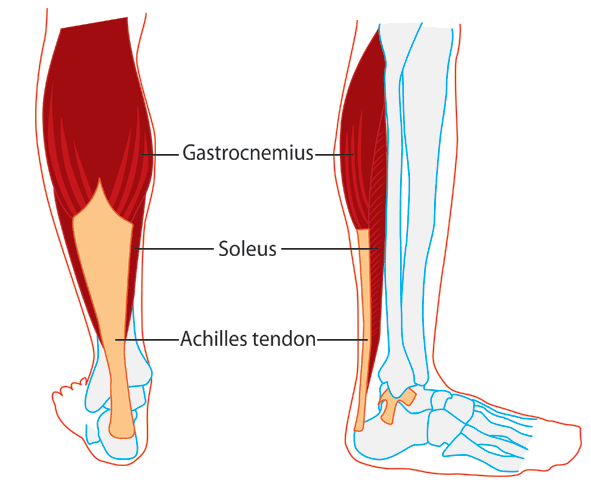
They flex the foot to allow you to plant on the balls of your feet. As you land when you walk or run or squat down to sit or perform exercises the calf muscles must stretch to allow your foot to flatten and your shin to come forward.
If your calf muscles are excessively tight you will constantly walk and stand on the balls of your feet this impairs your ability to move properly, to squat down and to walk normally.
Keeping the calves flexible is not only important for preventing calf tears but for preventing the ever troublesome Achilles tendonitis or rupture.
How do you stretch calf muscles?

1. Gastrocnemius stretch: Stand near a wall with one foot in front of the other, front knee slightly bent. Keep your back knee straight, your heel on the ground, and lean toward the wall. Feel the stretch all along the back leg. Hold for 30 seconds.
2. Soleus stretch: Same as the stretch mentioned before, but now you will bend the back knee making sure your heel stays on the ground. Feel the stretch along the bottom part of the back of your calves. Hold for 30 seconds.
Massage for Headaches
Massage is a natural alternative to pain medication, without side effects, that helps headaches and migraine pain
It promotes relieving muscle spasms and helps better blood circulation which reduces pressure in the head
In a recent study Chronic tension headache sufferers received massage therapy treatment directed toward neck and shoulder muscles. Headache frequency, duration, and intensity were recorded and compared with baseline measures.
The results of this study suggest that massage therapy is effective in reducing the number of headaches per week in chronic tension headache sufferers. Compared with baseline levels, headache frequency was reduced within 1 week of massage treatment. This reduction was maintained during the 4 weeks of the treatment period. A trend toward a reduction in the average duration of each headache event between the baseline period and the treatment period was also noted. On the basis of these results, we conclude that pain associated with chronic tension headache can be alleviated through specific massage therapy treatments directed at cranial and cervical muscles.
The muscle-specific massage therapy technique used in this study has the potential to be a functional, nonpharmacological intervention for reducing the incidence of chronic tension headache.


