Bad Posture = Back Problems? Maybe not...

Does bad posture cause back pain…some studies are starting to show…no, it actually doesn’t.

And here’s the Cliffs Notes version of “why”

Tissues adapt to stresses over time - In the same way your muscles get bigger the more you lift at the gym, your ligaments, joints & tendons will change and adapt to take on stress created by certain postures.

Tissue damage does not equal pain - If you were to chuck anyone over the age of 30 into an MRI you would have a VERY strong chance of finding some kind of significant damage, even in places without pain. Pain is complex & tissue damage is only one contributor to pain.

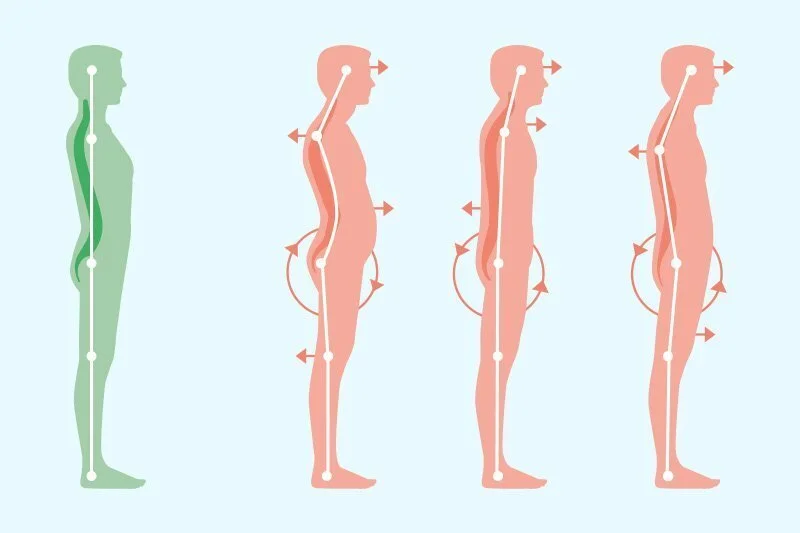
Different People are different - So, “bad” posture doesn’t always correlate with pain, because everyone has a unique structure. If you were to take 100 skeletons from 100 different people you would see big differences in the shape of the bones & spinal curves. Theses differences will to some extent tell the body the most comfortable way to sit/stand & move/ So, what’s “dysfunctional;” for one person might be nice & comfy for another person **typed as I’m hunched over a laptop comfortably on the floor**

So, because of these differences, comparing yourself and posture to some perfect model and trying to make corrections is super problematic.

Sooooo what do you do instead of posture you’re wondering, right???

Ensure you have good alignment when some sort of force is involved. During stationary standing or sitting, the stresses on your joints will be pretty small. Your body has years and years of experience to theses exact stresses thousands of times a day and is well adapted to them.

But on the flip side, during any sort of exercise, for example a heavy deadlift, the stress will be a lot greater and your body has less opportunity to quickly adapt to this. So your postural alignment matters greatly in that particular instance. Just the same as a jump/landing, sprint/quick directional change.

Next you want to change up your posture every once in a while. So don’t beat yourself up f you look like Quasimodo when you’re in from of your computer. Getting up and moving around a few times an hour will be better for you in the long run than stressing over keeping your shoulders back all the live long day.

Throw your good posture all the time thought process out the window, instead, stay comfortable, keep moving, and use alignment/form during strenuous movements. 

WHAT THE BACK!?

The back consists of the posterior aspect of the body.

It’s bony elements are mainly vertebrae, although ribs, pelvic bones and skull contribute to the back's skeletal framework too. Associated muscles and ligaments interconnect the vertebrae, ribs, pelvic and skull with each other. 

This connection reveals why we, as a massage therapist, love to work through your gluteal muscles or hip flexors (even if you don't feel any pain) and have a closer look through your chest and front neck muscles (pectoralis muscles, scaleni, SCM to name a few) if you have back pain.


The curvature of the vertebral column is concave anteriorly in the thoracic and sacral region whereas in the cervical and lumbar region it is concave posteriorly. With this equal distribution the center of gravity is aligned, which is important for the body's weight balance. If the body's weight is centered on the vertebral column it will expend the least amount of muscular energy to maintain an upright bipedal stance.

To support your spine it is very important to train your posture as often as possible. This includes all trunk muscles but also your hip muscles to maintain your correct curvature.


The major bones of the back are 33 vertebrae. Our spine consists of seven cervical, twelve thoracic, five lumbar, five sacral (which fuse into a single bone, the sacrum) and three to four coccygeal vertebrae (often fused into a single coccyx).

A typical vertebra has a vertebral body and a vertebral arch. 


The main purpose of the vertebral body.

  • Weight bearing: It carries the body weight. The more weight a vertebra has to carry the bigger its size which explains why a cervical vertebra is tiny and fragile in comparison to a lumbar vertebra.

The arch has a totally different task. 

  • Protection: It forms the lateral and posterior walls of the vertebral canal which starts from the very first cervical vertebra (atlas) to the last sacral vertebra. It's a protection for the structures that are in this canal which are the spinal cord and its protective membranes, blood vessels, connective tissue, fat and spinal nerves

  • Attachments: for muscles and ligaments

  • Levers: for the action of muscles

  • Sites of articulation: with adjacent vertebrae

To keep your spine fully functional it's indispensable to use it

If there is no stimuli or to little your body will slowly degenerate and get weaker and won't have the ability to react appropriately. It's a simple fact that if you don't use it you will lose it. 

Why should your body keep up a function and waste energy and resources?

So go for a walk, run, exercise it doesn't matter which activity you prefer but move. The importance is that you give your spine different stimuli and therefore your body needs to adjust to it.


fascia /ˈfeɪʃɪə,ˈfeɪʃə/

  • a thin sheath of fibrous tissue enclosing a muscle or other organ.

MuscleFascia.jpg

what IS fascia?

To know the importance of it we need to understand what fascia is in general.

Fascia is your connective tissue network, it’s like a web that is connected from head to toe fusing everything in your body. 

It gives us our body shape and holds us together. Actually you can look at it as a “second skin”. 

Fascia can be found immediately underneath the skin, around muscles, group of muscles, organs, nerves, bones and cells. For example it allows the muscles, organs and nerves to move freely alongside other structures and it reduces friction in between them.


So why is this fascia so important for us and our body?

In a healthy state the fascia is relaxed and very flexible and this capacity allows us to respond to movements and activities properly. 

But as every other structure, fascia is not free of any damage. Fascial dysfunction can occur because of lack of movement, poor postures, trauma and unhealthy diet.

If so, it becomes tense, inflexible and it loses it’s ability to slide and glide. 

AND IF IT’S NOT FUNCTIONING WELL?

Fascial dysfunction is associated with pain, stiffness, fatigue and limited range of motion. If you exercise and you have one part in your body that has lost his flexibility it will tighten somewhere else to compensate it’s immobility. This in return can cause pain in body parts even if you haven’t had any problems before. 

It is very important to think of fascia as one whole piece. If a trauma occurs there will be a reaction of your body,  affecting a part of it for good or worse.

Therefore, it is necessary to keep your fascia agile so it can react to every movement or activity without compensation. If your fascia loses this ability the risk of getting injured increases even more.

What can you do to keep your fascia healthy?

  • Water: Fascia consists of 70% of water so keep yourself hydrated. 

  • Massage: This will break the adhesions between the fascia and the other tissues next to it. Keeping the lubrication and a healthy range of motion

  • Cupping: The negative decompression treats fascial adhesions and therefore releases fascial restrictions and tension

  • Foam roller: Foam roll your fascia but consider that this tissue is really slow in reacting. Roll slowly through it or stay on sore spots up to 5 minutes until you feel a release. “No pain, no gain” is clearly the wrong approach.

    • Where? : Everywhere actually… Start with your feet and work your way up

  • Move more: if you don’t use it, you lose it!